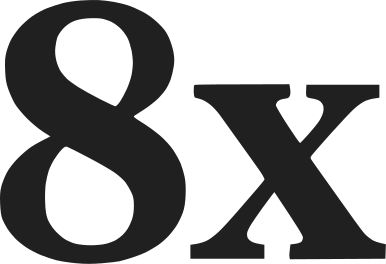
Most brands treat viral content like it’s rare, unpredictable, something you get lucky with once.
That's bullshit.
Virality isn't magic.
The brands breaking through aren't waiting for inspiration. They're running industrial-scale content operations that treat virality like a numbers game, because that's exactly what it is.
Volume Beats Perfection
You don't need brilliant creative. You need enough shots on goal that statistics work in your favor.
The uncomfortable truth about viral content:
- Most of what you make will flop
- You can't predict what will hit
- The algorithm rewards frequency more than quality
- Platforms favor accounts that post daily (or more)
The implication: You need to produce so much content that 90% can fail and you'll still win.
Here's the framework nobody wants to admit they're using:
Phase 1: Steal What's Already Working
The Format Heist Strategy
Every platform has 5-10 formats currently dominating the algorithm. Your job isn't to invent new ones—it's to identify and replicate them faster than competitors.
The 7-day audit:
Day 1-2: Pattern Recognition
- Scroll your target platform for 2 hours daily
- Screenshot every video with 500K+ views in your category
- Note the pattern: hook structure, pacing, visual style, audio choice
Day 3-4: Deconstruction
- Break down your top 20 saved videos
- Identify the common elements (not the topic—the structure)
- Extract the template: "3-second pain hook → 5-second solution tease → 7-second proof"
Day 5-6: Replication Testing
- Take the exact structure that's working
- Swap in your brand/product/message
- Produce 10 variations using the same template
Day 7: Launch and Analyze
- Post all 10 throughout the week
- Track which specific elements correlate with performance
- Double down on winners
The Speed Advantage
When you spot a format taking off, you have 48-72 hours before it's saturated.
Brands that can go from "I see this trend" to "my version is live" in 24 hours capture disproportionate value. Brands that take two weeks to get legal approval watch from the sidelines.
Phase 2: Build a Content Factory, Not a Creative Studio
Creative studios produce one brilliant piece per month. Content factories produce 10 decent pieces per day.
The Multi-Account Distribution System
One account is a single point of failure. Smart operators run 3-7 themed accounts across platforms.
The structure:
Hub Account (1)
- Official brand voice
- Polished, credible content
- What you'd show investors or press
Experimental Accounts (3-5)
- Different angles on your core message
- Higher risk tolerance
- Test formats without endangering brand account
- Different creators/personalities
Niche Vertical Accounts (2-3)
- Hyper-focused on specific use cases or demographics
- Speak the exact language of one segment
- Higher conversion despite lower reach
Why this works:
- Algorithm treats each account independently (more chances to break through)
- Failures on experimental accounts don't hurt your brand
- You can test contradictory messaging simultaneously
- When one account pops, cross-promote to others
The 50-Piece Monthly Quota
Here's the math that makes virality inevitable:
- Post 30 pieces of content per month (per account)
- Industry average viral rate: 2-3% of posts
- Expected viral hits per month: 1-2
Most brands post 10 times per month and wonder why nothing hits.
At 10 posts/month with 2% viral rate, you'll go viral once every 5 months. At 30 posts/month, you'll go viral 1-2 times monthly.
The Creator Network vs. In-House Team
In-house teams bottleneck at 10-15 pieces per month. Creator networks scale infinitely.
The framework:
Maintain relationships with 20-30 creators across tiers:
Tier 1: On-Retainer Creators (3-5)
- Monthly fee for guaranteed content output
- Deep product knowledge
- Fast turnaround (24-48 hours)
- Use for time-sensitive trends
Tier 2: Project-Based Creators (10-15)
- Pay per piece
- Bring fresh perspectives
- Use for experimental formats
- Rotate to avoid creative fatigue
Tier 3: Affiliate/Performance Creators (10+)
- No upfront cost
- Commission on conversions
- Scale without budget constraints
- Natural filter for effective content
With this structure, you can produce 50+ pieces monthly without hiring a single full-time employee.
Phase 3: The Format Testing Matrix
Don't guess what will work. Test systematically.
The 10-3-50 Production Cycle
Week 1-2: Test 10 Different Formats
Produce one piece in each format:
- Problem/solution hook (pain → product)
- Before/after transformation
- Trendjacking (riding existing viral sounds/formats)
- Educational breakdown (teach while showcasing)
- Behind-the-scenes/authentic chaos
- User testimonial/social proof
- Comparison content (your way vs. old way)
- Provocative take/hot opinion
- Relatable struggle humor
- Data/results-driven proof
Week 3: Identify Top 3 Performers
Kill everything except the formats that delivered:
- Highest engagement rate (saves + shares matter most)
- Best conversion signal (comments asking how to get it)
- Sustainable to replicate (can you make 20 more?)
Week 4-12: Produce 50+ Variations of Winners
Take your top 3 formats and create endless variations:
- Same structure, different hook
- Same structure, different creator
- Same structure, different use case
- Same structure, different trending audio
- Same structure, different visual style
Phase 4: The Replication Machine
When something goes viral, replicate immediately.
The 48-Hour Replication Protocol
Hour 0-6: Deconstruct the Winner
- What was the hook? (exact wording/visual)
- What was the structure? (timing, pacing, beats)
- What made it shareable? (emotion triggered, relatability factor)
- What audio/visual elements were used?
Hour 6-24: Produce 5 Variations
- Keep the structure identical
- Change only the variables (hook angle, creator, context)
- Shoot multiple endings to A/B test
Hour 24-48: Deploy Across Network
- Push variations across your account network
- Stagger posting to test different time slots
- Monitor in real-time and adapt
The goal: Extract every ounce of value from the viral format before the algorithm moves on.
The Remix Strategy
Don't just replicate your own viral content—remix everyone else's.
When you see a competitor or adjacent brand go viral:
- Identify the format (not the message)
- Strip out their branding
- Insert your product/angle
- Post within 48 hours
Phase 5: Convert Volume Into Velocity
High volume means nothing if you're not learning and adapting in real-time.
The Daily Performance Review
Every 24 hours, analyze:
- Which posts exceeded 2x your average engagement?
- What specific elements (hook, audio, format) were present?
- Which posts flopped despite using "proven" formats?
- What external factors (trending topics, news) might have influenced performance?
The key question: What can we immediately replicate or kill?
The Content Graveyard
Most brands keep producing content that doesn't work because "we already planned it."
Ruthless elimination protocol:
- If a format fails 3 times in a row, kill it for 30 days
- If a creator's content consistently underperforms, rotate them out
- If an account isn't growing after 50 posts, rebrand or abandon
- If a platform isn't delivering results after 90 days, reallocate resources
Volume only works if you're killing bad content as fast as you're creating new content.
The Uncomfortable Truth
Most brands fail at viral growth because they're trying to be artists. They want every piece to be brilliant, considered, on-brand.
The brands winning are treating content like a numbers game:
- Produce 30 pieces per account to get 1-2 viral hits
- Replicate that hit 20 times before it dies
- Test 10 new formats while scaling the winner
- Rinse and repeat
The choice:
- Post 10 thoughtful pieces per month and hope one breaks through
- Post 30 rapid-fire pieces per month and mathematically guarantee virality
The algorithm doesn't reward the best content. It rewards the most content that meets minimum viability.
Now go flood the zone.


